Hotel History
1700s
Until the latter part of the 18th century, there was no community of Wayne. Fields, orchards, brooks and woodland supported isolated farmers. Long-distance roads resulted in the need for inns, which in turn helped the economy. The railroad, first tracked in 1832, brought visitors.
1800s
By the beginning of the 19th century, Wayne comprised several churches, a sawmill, a number of schools, a hardware store and Radnor Scientific and Musical Hall. Between 1864 and 1870, James Henry Askin bought 293 acres of farmland. These properties, covering the center of current Wayne, formed his estate: ‘Louella’, named for two of the purchaser’s daughters, Louisa and Ella Askin. His mansion (Louella House) was completed in 1866 and was later used by the Armitage School and then as a hotel in the 1890’s. It is now Louella Apartments. Louella developed into modern Wayne after A.J. Drexel and George W. Childs completed their plans to build a model suburban community.
The railroad stop, once called Cleaver’s Landing, was renamed in honor of General Anthony Wayne (many items of the General’s personal battle and ceremonial regalia are on display in the U.S. Mint in Philadelphia). Because of easy rail access to Philadelphia, Wayne joined other railroad stops as a summer resort. The summer trade was capitalized on and the Bellevue Hotel was built in 1881. It accommodated up to 200 guests and had a boardwalk to the train station. After nineteen years of service to the community, the Bellevue was destroyed by fire in March 1900. The Bell Atlantic building now stands on the site.
The next natural progression for such a thriving area was an increase in the development of homes. In 1889, six styles of house were advertised ranging in cost from $3500 to $7000. By the end of that year, 100 homes had been built north of the railroad. Of course, merchants followed population and Wayne was a thriving town by the turn of the century, with sixty daily trains to the city. It had, in fact, become one of the country’s first planned suburbs.
1900 – 1950
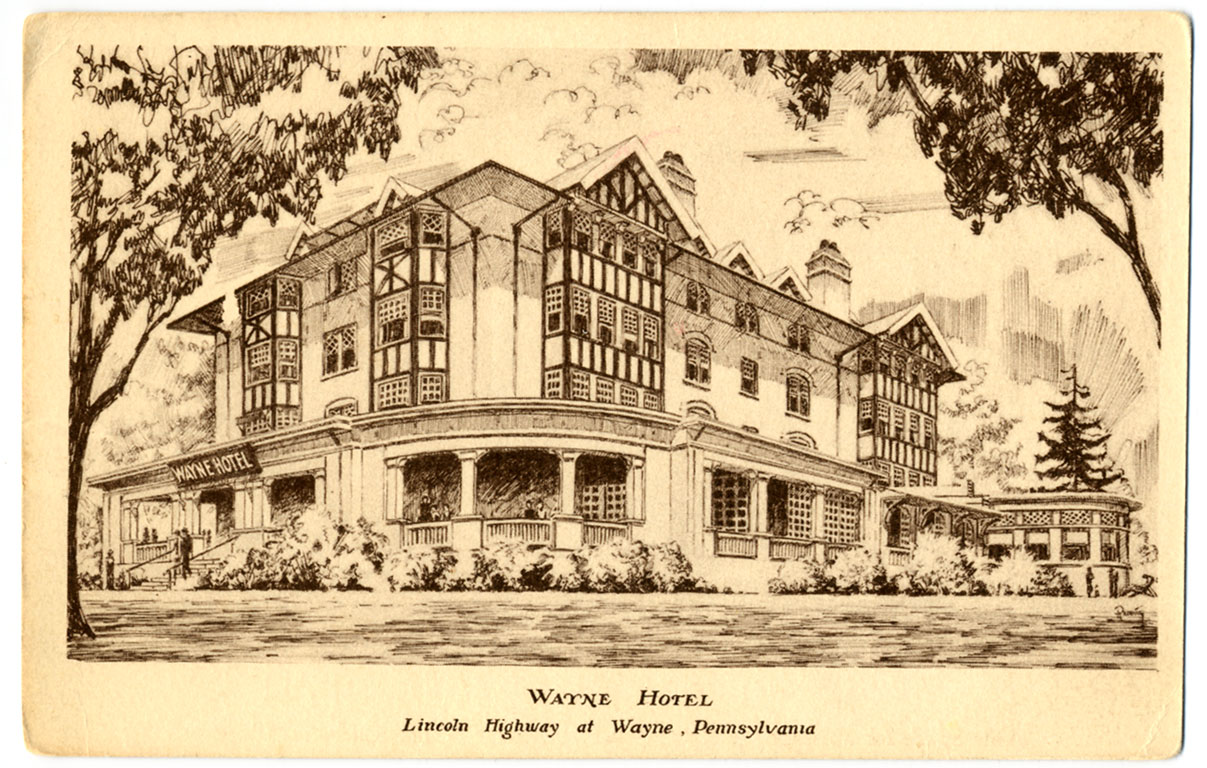
When summer trade fell off for want of the Bellevue Hotel, the Wesley Hotel was opened on North Wayne Avenue. Then, in 1906, The Waynewood Hotel (now the Wayne Hotel) was constructed by Jonathan D. Lengel for Mr. Charles Wood. A painting of General Wayne in the woods was commissioned to hang over the fireplace-hence ‘Waynewood Hotel.’ The brick and half-timbered building was a wonderful example of the Tudor Revival style of architecture.


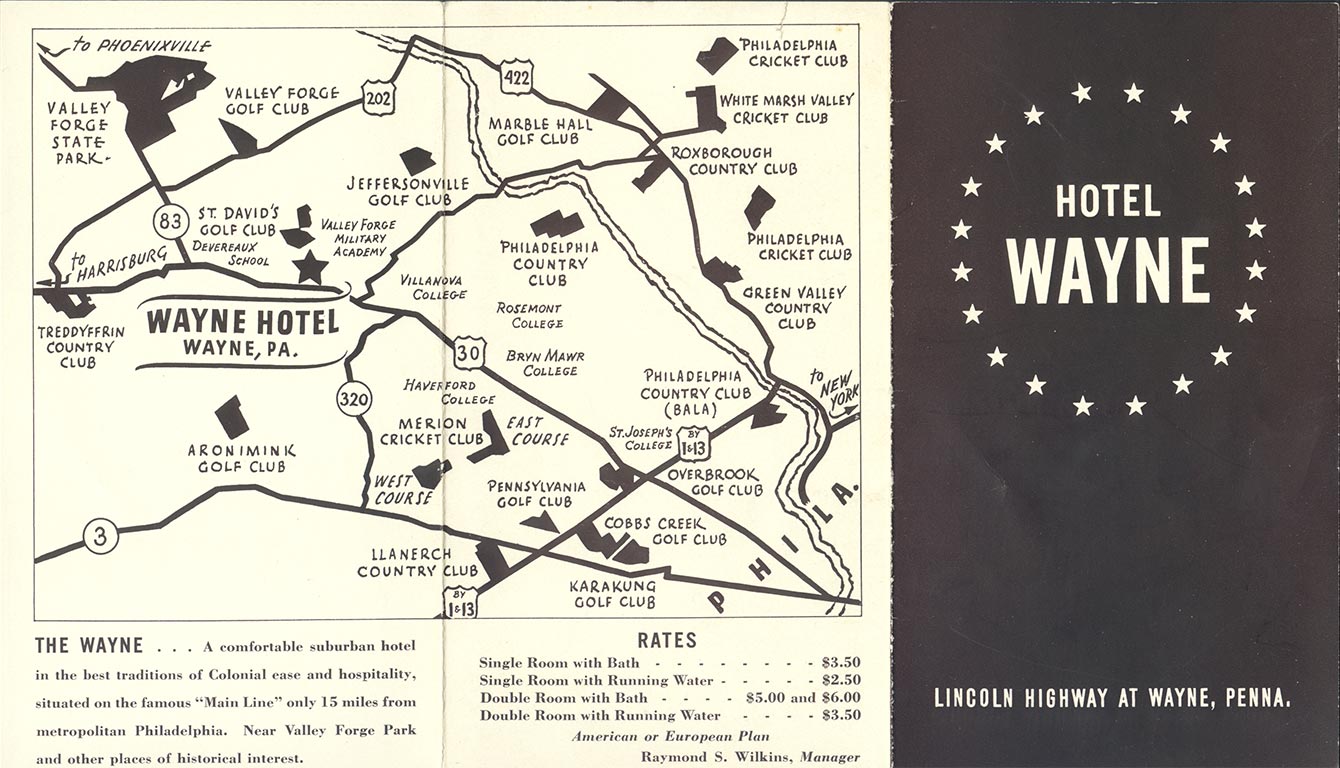
In March 1926, the Hotel was purchased by Paul N. Furman and was brought under the management of Main Line Hotels Corporation. Nearly $50,000 was spent to make the newly named Wayne Hotel one of the most completely equipped, most modern and most home-like small hotels in Pennsylvania. Bathrooms were added, running water was placed in every room that was not equipped with a bath, and retiring rooms were installed for men and women. New linen, silver, glassware, china, blankets and bedding were purchased and many rooms were refurbished. Extensive work was done on the dining room, which was made more cheerful and inviting. The brochure described the Hotel in the following terms: “This delightful hotel in the beautiful Main Line is particularly suited to the tourist interested in Philadelphia and its landmarks. With the broad lawn and fine old elm trees, Wayne Hotel is removed from the city’s noise and heat, yet but 15 minutes by car and 30 minutes by frequent train service from the center of Philadelphia.” Raymond S. Wilkins was the Manager at this time.
During the renovation of the 4th floor in 2009, staff discovered a letter from Hotel Manager H.M. Ward dated June 1935. The letter is addressed to Colonel Milton G. Baker at Valley Forge Military Academy. It confirms an agreement between the Hotel and the Military Academy for a ¼ page advertisement in the Academy’s periodical “Crossed Sabres” at a cost of $30.00. The letterhead describes the hotel’s amenities as follows: “Single Rooms or Suites, Strictly Modern, Three Restaurants, Garage, French Beauty Salon, Billiard Room, Public Stenographer”.
By 1948, the Wayne Hotel was advertised as the only transient hotel between Philadelphia and Lancaster.

1950 – Present
The Presbytery of Philadelphia bought the building in 1959 and began renovations to ready the building for its next role; as Wayne Hall, it became home to retired senior citizens. Before the building was ready to welcome the senior residents, the foyer was used by Wayne Presbyterian Church for Sunday School.
1982 saw another change of ownership, and having been acquired by the Congregation Or Shalom, Wayne Hotel was utilized as a synagogue. Services were held in the dining room and the rooms on the second floor were used for religious study. The building was vacated in 1984.
Soon after, Wayne Hotel was purchased by local entrepreneur Stephen W. Bajus and re-opened on September 10, 1985. The Hotel had undergone an extensive $1.5 million refurbishment and had been restored to an elegance of time past, complete with amenities expected by the modern traveler. Leon Toroian was consulted on design and created a classic mood with Victorian accessories. A sprinkler system and air-conditioning were installed during the refurbishment. By August 1987, the Pennsylvania Historic Preservation Board was considering the Hotel for nomination to the National Register of Historic Places. On November 5, 1987, Wayne Hotel was officially entered in the Register.
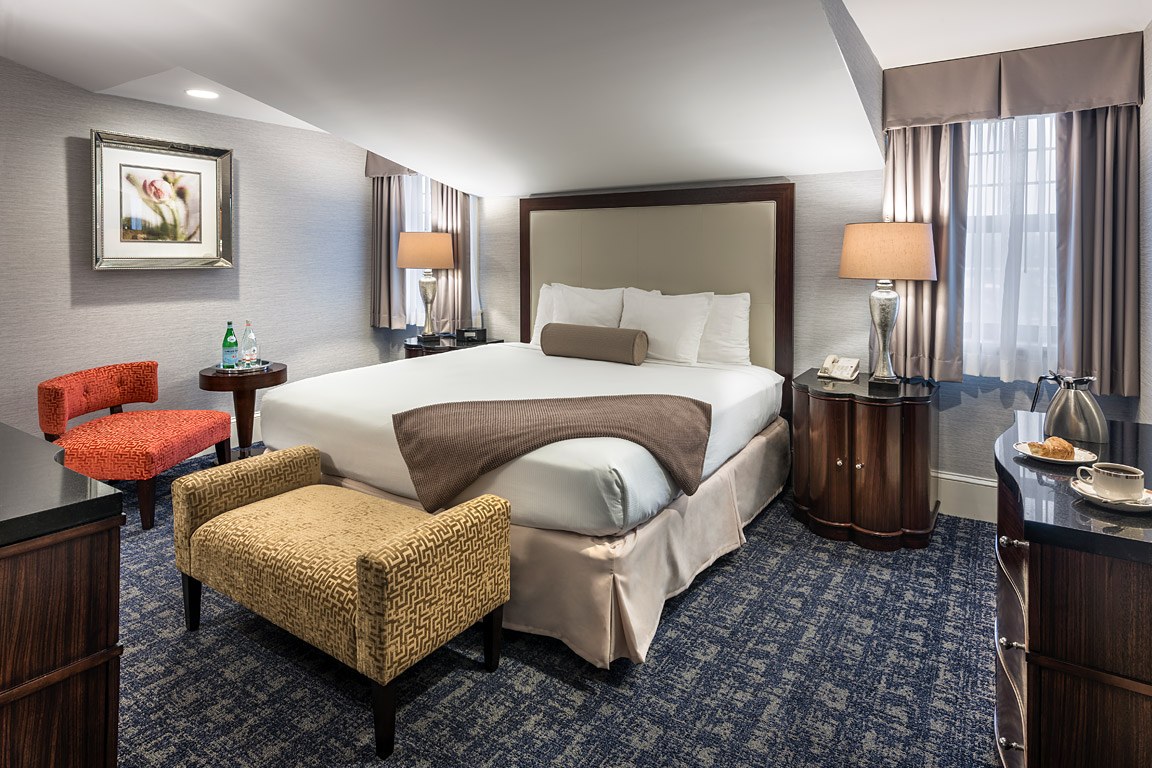
In 2011, the hotel completed its most extensive renovation since being built. After a complete refurbishment, the Wayne Hotel has been re-invented with subtle elegance to offer accommodations with amenities expected by the modern traveler. We invite you to visit and see for yourself.